U as untranslated

The possibility to communicate with people using another language, to watch a movie or read a book in its original idiom is one of the human capabilities more similar to a superpower.

I started learning languages very young but with little effect.  My first trip to Burkina Faso convinced me of the necessity to improve and a subsequent seminar in Kandersteg consolidated that resolve.  I was following the discussion in the French group, to understand something of what was said but then had to move to the English group to express my ideas.

More courses followed.  At private schools and at Rome University (strangely quite good).  Then I had the opportunity to attend a French course at the Council of Europe Youth Center in Strasbourg.  A worthwhile experience.

After Cambodia, I went to London and while looking for a job I was studying English, of course.  And I continued afterwards (didn’t find any job, though).

I have some basic notions of spoken Khmer and happily noticed that when going back to the country after several years, the little knowledge I had of that strange language was kept almost intact, as freezed in my memory.

Still, communication is not made by linguistic knowledge alone.  Actually, the most important factor is the urge to pass a message and to get some from the interlocutors.  Without that any conversation remains an empty exercise.
For the kind revolution, I am in

Mr Pisapia is working for the impossible task to put together the Italian left.  For many he is too close to Mr Renzi, for others he is to weak, someone may even think that he is too radical.

I like the man and agree on the objective.  I also support the aim to get to govern, which implies the necessity to mix with others, as there is not a left majority in Italy.

Yes, I would like him to be careful with Renzi, but I think he is not naive and the reality will eventually determine the politics.

I am in, but I am not sure how many will join.  But this has never been a problem.

The dogs’ sense for justice

I read an article stating that dogs share with humans an innate sense of justice and react if treated unfairly with comparison to fellow animals.

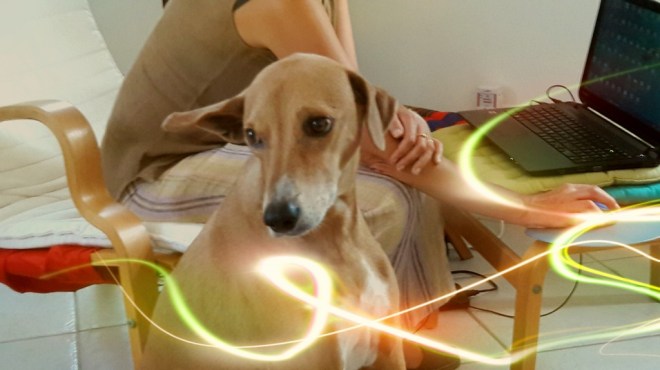
This reminded me of our dog’s attitude when playing badminton in the garden.

He was very interested in the game and especially in the shuttlecock we were exchanging.

I drew on that interest having him getting the plastic projectile whenever it felt on the ground. In order to motivate him, I was offering him a little piece of bread every time.

Quite astonishingly, he was playing his role very fairly, without any training or insistence, and wasn’t trying to get the shuttlecock a second time after receiving his bread, even if he could have reached it before me.

That is even more surprising because after 10 seconds, when we re-started the game, he was indeed trying to get the thing flying across the net.

So not only sense of justice, but also respect of the rule of law.

Indeed, the first element is shared with humans, as a primordial sense of justice might motivate behaviors and acts hardly understandable otherwise (and a recent example is the gentleman from Tunisia whose sacrifice started the Democracy Spring).  However, I am not so sure about the second part.

Children do not naturally consider respect of rules as the convenient approach for survival and most of grown-ups don’t do either.  Would a Planet of Dogs be more ethical than our own?

image211